

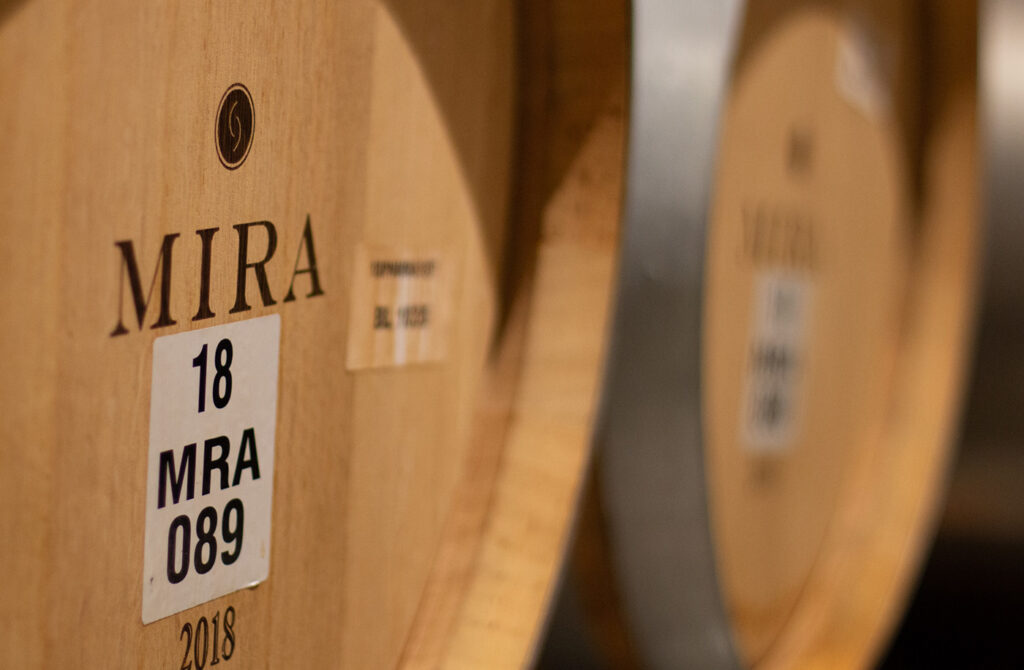
French vs American Oak in Napa Cabernet: Structural Impacts
In Napa Valley, oak is not a flavoring tool. It is a structural decision.
For collectors, the question is often framed in simple terms: French oak or American oak—which is better? But at the highest level of winemaking, the conversation is not about preference. It is about how oak shapes tannin, texture, and the long-term evolution of Cabernet Sauvignon.
At Mira, we approach oak as an extension of the vineyard—another layer of architecture that must align with site, vintage, and intent. Understanding the difference between French and American oak is essential to understanding how a wine will age.
The Origin of the Barrel Matters
Oak is not a neutral vessel. Its grain, chemistry, and seasoning influence how a wine develops during élevage.
French oak (typically from forests like Allier, Tronçais, or Nevers) is known for:
- Tight grain structure
- Subtle aromatic contribution
- Gradual oxygen exchange
- Fine tannin integration
American oak (primarily from Missouri and surrounding regions) tends to have:
- Wider grain
- More pronounced aromatic impact
- Faster flavor extraction
- A different tannin profile
These differences are not stylistic accidents—they are structural inputs that influence how a wine evolves over time.
Grain and Oxygen: The Hidden Mechanics
One of the most important—and least discussed—differences between French and American oak is grain tightness.
French oak’s tight grain allows for slower, more controlled oxygen ingress. This gradual micro-oxygenation helps:
- Soften tannins incrementally
- Stabilize color
- Integrate structure over time
The result is often a wine that feels more linear and composed, with tannins that resolve slowly and elegantly.
American oak, with its wider grain, can allow for slightly more rapid oxygen exchange. This can:
- Accelerate tannin softening
- Bring flavors forward earlier
- Create a more immediate sense of roundness
Neither is inherently better. The key difference lies in timing and trajectory.
Tannin Integration and Mouthfeel
Oak contributes its own tannins to the wine—but more importantly, it influences how grape tannins evolve.
French oak tends to support:
- Fine-grained tannin structure
- Precision and tension
- A more restrained, layered mouthfeel
These wines often feel coiled in youth, requiring time for full integration. Over years or decades, they develop remarkable clarity and detail.
American oak can contribute:
- Broader tannin expression
- A rounder, more immediate texture
- Greater early accessibility
The structural impression is often one of generosity and openness, particularly in the first decade of life.
For collectors, this distinction is critical. It influences not just how a wine tastes today—but how it will unfold over time.
Aromatics vs Structure
American oak is often associated with more recognizable aromatic signatures:
- Vanilla
- Coconut
- Sweet spice
French oak tends toward:
- Cedar
- Subtle spice
- Toasted wood
- Structural framing rather than overt flavor
While these aromatic differences are noticeable, they are secondary to structure. The more important question is not what the oak tastes like—but how it supports or frames the wine’s architecture.
Oak and Ageability
The relationship between oak and longevity is often misunderstood.
French oak is frequently favored for age-worthy Napa Cabernet because it:
- Integrates more slowly
- Preserves structural tension
- Supports long-term evolution
Wines aged in a high percentage of French oak often require patience, but reward it with complexity—moving from primary fruit into graphite, tobacco, cedar, and earth over time.
American oak, when used thoughtfully, can still support aging. However, its more immediate integration and pronounced aromatic profile can make wines feel more accessible earlier in their life cycle.
Again, this is not a limitation—it is a stylistic and structural choice.
The Role of Toast and Cooperage
Beyond origin, toast level and cooperage decisions further refine oak’s impact.
- Light toast preserves more of the wood’s structural influence
- Medium toast balances structure and aromatic contribution
- Heavy toast emphasizes smoke, spice, and surface-level flavor
At the highest level, producers select barrels not just by origin, but by:
- Forest
- Grain tightness
- Seasoning time (air-drying vs kiln)
- Cooperage style
These micro-decisions shape how oak integrates over the course of aging—and how seamlessly it disappears into the wine.
Napa Cabernet and Oak Alignment
In Napa Valley, Cabernet Sauvignon often carries significant natural power—ripe tannins, dense fruit, and high extract. Oak must be carefully matched to that structure.
- Too much aggressive oak can overwhelm site expression
- Too little structural support can leave the wine unresolved
French oak is often chosen for its ability to refine rather than dominate. It allows Napa Cabernet to retain its power while gaining precision.
American oak, when used judiciously, can enhance richness and approachability—but requires careful calibration to maintain balance.
The Collector’s Perspective
For collectors, oak influence is not just about flavor—it is about drinking windows and evolution.
Wines aged predominantly in French oak may:
- Open more slowly
- Reward extended cellaring
- Reveal complexity in layers over time
Wines with a higher proportion of American oak may:
- Show earlier generosity
- Offer a broader early drinking window
- Emphasize richness and immediacy
Understanding oak helps collectors decide not only what to buy, but when to open.
The Mira Approach
At Mira, oak is never applied—it is integrated. Barrel selection is guided by vineyard character, vintage conditions, and the desired aging trajectory of the wine.
Our focus is on:
- Preserving site expression
- Refining tannin structure
- Supporting long-term evolution
In practice, this often means a preference for tight-grained French oak, selected for its ability to frame rather than overshadow. The goal is not to make oak visible, but to make structure seamless.
Because in Napa Cabernet, the most important element is not power—it is precision over time.
Structure Over Style
The debate between French and American oak is often framed as stylistic. In reality, it is structural.
French oak tends to emphasize:
- Precision
- Tension
- Longevity
American oak tends to emphasize:
- Generosity
- Early integration
- Aromatic presence
Both have a place in Napa Valley. But for wines built to evolve over decades, the question is not which oak is more expressive today—it is which oak allows the wine to become more expressive over time.
That is where structure matters most.