

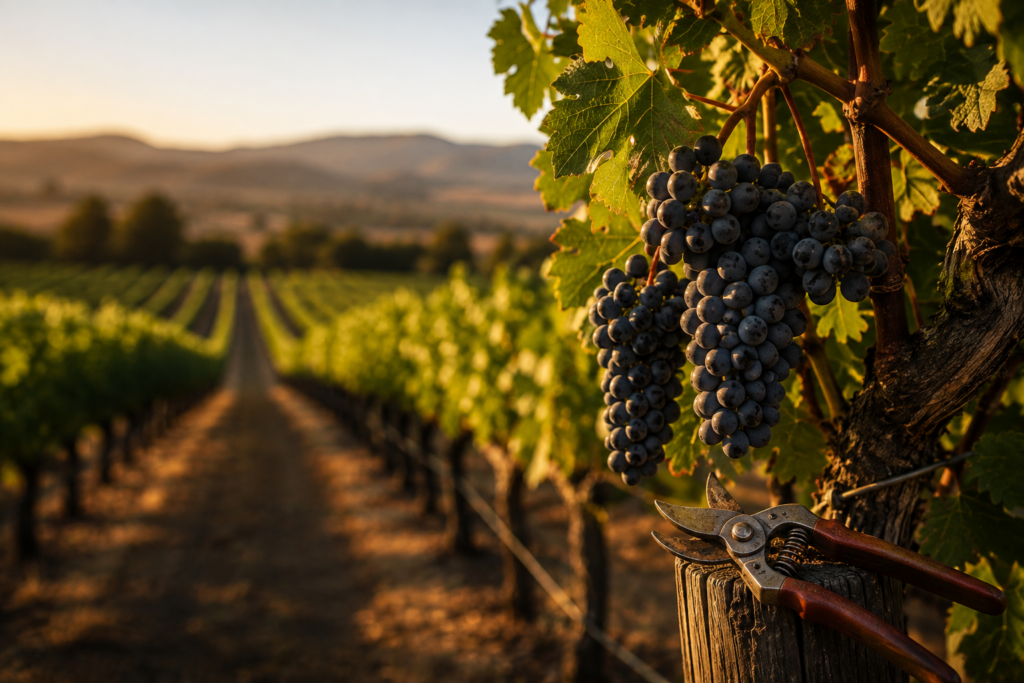
What Happens During Harvest in Napa Valley? A Technical Walkthrough
For those who love Napa Valley Cabernet Sauvignon, harvest is one of the most consequential moments of the year.
It is also one of the most misunderstood.
From the outside, harvest can look simple. Grapes turn dark, the weather cools, and the fruit is picked. But deciding when to pick is one of the most important decisions a winemaker makes. A few days can influence acidity, tannin, alcohol, aromatics, and ultimately how a wine develops over years in the cellar.
For collectors, understanding harvest offers a different way to think about the wines in your cellar. Vintage character begins long before the bottle is filled.
It begins in the vineyard.
Ripeness Is More Than Sugar
One of the first things people associate with grape ripeness is sugar.
As grapes mature, sugar levels rise, and winemakers measure this using Brix. Higher Brix generally means greater potential alcohol during fermentation.
But sugar is only one piece of the equation.
A grape can have plenty of sugar and still not be fully mature from a winemaking perspective.
Winemakers are also evaluating:
- Acidity
- Tannin development
- Seed and skin maturity
- Flavor development
- Color
- Aromatic intensity
- Overall balance
This is where the concept of phenolic ripeness becomes important.
Phenolic compounds, found primarily in the skins and seeds, contribute to color, tannin, texture, and some of the wine's aromatic character. As Cabernet Sauvignon matures, the goal is often to reach a point where these compounds have developed enough to provide structure without creating harsh or overly astringent tannins.
The challenge is finding that balance.
Sugar vs. Structure
Imagine two vineyards reaching the same sugar level on the same day.
That does not necessarily mean they are ready to harvest at the same time.
One vineyard might have beautifully developed tannins and vibrant acidity, while another may still show green, firm phenolics. Conversely, waiting longer may allow tannins and flavors to develop, but potentially at the expense of acidity or with significantly higher sugar.
This is why harvest decisions cannot be reduced to a single number.
For Cabernet Sauvignon, particularly, structure matters as much as concentration.
The best picking decision is often the point at which the different components of the grape have come into balance.
Walking the Vineyard
Before harvest begins, winemakers and vineyard teams spend considerable time tasting grapes directly from the vines.
They are looking for more than sweetness.
A grape is crushed between the fingers. The skin is examined. Seeds are tasted. Juice is evaluated. The fruit is observed across different blocks and sections of the vineyard.
This hands-on evaluation can reveal things that laboratory analysis cannot.
Are the tannins still angular?
Does the fruit taste fresh and vibrant?
Are the seeds still green?
Has the flavor moved from simple sweetness toward greater depth and complexity?
Does the acidity still provide energy?
These observations help create the larger picture.
Not Every Block Is Picked at Once
A Napa Valley vineyard is rarely harvested in a single pass.
Different blocks, clones, exposures, elevations, and soil types can mature at different rates. Even within the same vineyard, fruit facing different directions can experience different levels of sunlight and heat.
A winemaking team may therefore make several picking decisions over the course of harvest.
This is one reason vineyard knowledge is so important.
Understanding how a particular site behaves year after year allows a winemaker to recognize subtle changes in the fruit and respond accordingly. Read our article: Mountain Fruit vs. Valley Floor: What Ages Longer in Napa?
Weather Changes Everything
Harvest decisions become particularly important when weather is approaching.
A forecast for rain, an early heat event, or a significant temperature shift can change the equation quickly.
If fruit is nearly ready, a winemaker may decide that preserving its current balance is preferable to waiting for additional ripeness.
Other years allow more patience.
That flexibility is essential in Napa Valley, where growing seasons can vary considerably from year to year.
The vintage is, in part, the record of these decisions.
The Importance of Diurnal Shifts
Napa Valley's warm days and cooler nights are another important part of the harvest equation.
Warm daytime temperatures encourage photosynthesis and ripening. Cooler nighttime temperatures help preserve acidity and slow the pace of maturation.
This day-to-night temperature difference, known as the diurnal shift, can help Cabernet Sauvignon develop ripe fruit character while retaining the freshness needed for balance.
For collectors, this balance becomes increasingly important as a wine ages.
A wine with concentration but insufficient freshness can feel heavy over time. A wine with concentration, acidity, and well-developed tannins has a much stronger structural foundation for aging.
The Final Decision
Eventually, the winemaker has to make the call.
There is no perfect formula.
The decision is a synthesis of vineyard observations, analytical data, weather forecasts, historical knowledge, and experience.
The question isn't simply:
"Are the grapes ripe?"
It is:
"Are the grapes balanced?"
That distinction is fundamental.
Picking too early can result in wines with underdeveloped tannins and green or vegetal characteristics. Waiting too long can push sugar and alcohol higher while diminishing freshness.
The ideal moment is when fruit, acidity, tannin, flavor, and structure come together.
From Vineyard to Cellar
Once harvested, Cabernet Sauvignon moves quickly from vineyard to winery.
The fruit is sorted, destemmed, and prepared for fermentation. From there, decisions around extraction, fermentation temperature, maceration, and aging begin shaping the final wine.
Read our article: Extended Maceration: Does it Improve Ageability?
But those choices are building upon something that cannot be recreated in the cellar: the condition of the fruit at harvest.
This is why harvest is so important when considering vintage character.
The finished wine reflects not only what happened during the growing season, but also when the winemaking team decided the fruit had reached its moment.
Why Harvest Matters to Collectors
For wine collectors, harvest offers another lens through which to understand vintage variation.
Two Napa Cabernet Sauvignons can come from the same vineyard and be made by the same winemaking team, yet express themselves differently because the growing season demanded different decisions.
One year may reward patience.
Another may require an earlier pick.
One vintage may produce wines marked by powerful concentration. Another may favor freshness, precision, and aromatic complexity.
Neither is necessarily better.
They are simply different expressions of the vineyard and the year.
And that is ultimately what makes collecting Napa Valley wine so rewarding.
Every bottle preserves a moment in time.
Harvest is where that story begins.